Absent
The AI doesn't cite you
You don't exist in the buying conversation. Your competitor does.

GEO guide · updated October 2026
In 2025, 76% of the pages cited by AI assistants came from Google's top 10. One year later: 38%. Ranking first on Google no longer guarantees you exist in ChatGPT. Here is the complete method to measure your place in AI answers, and take it back: from framing to measuring AI traffic, with the real numbers from our audits.
×5.8
AI traffic in one year on a real case, method applied
2,527
AI searches analysed in a single audit
21
technical AI accessibility checks, free to test
Updated on · by Franck Neuenschwander
The short answer
A GEO audit measures, factor by factor, whether a brand is absent, mentioned or recommended in the answers of AI assistants (ChatGPT, Gemini, Perplexity), then explains why.
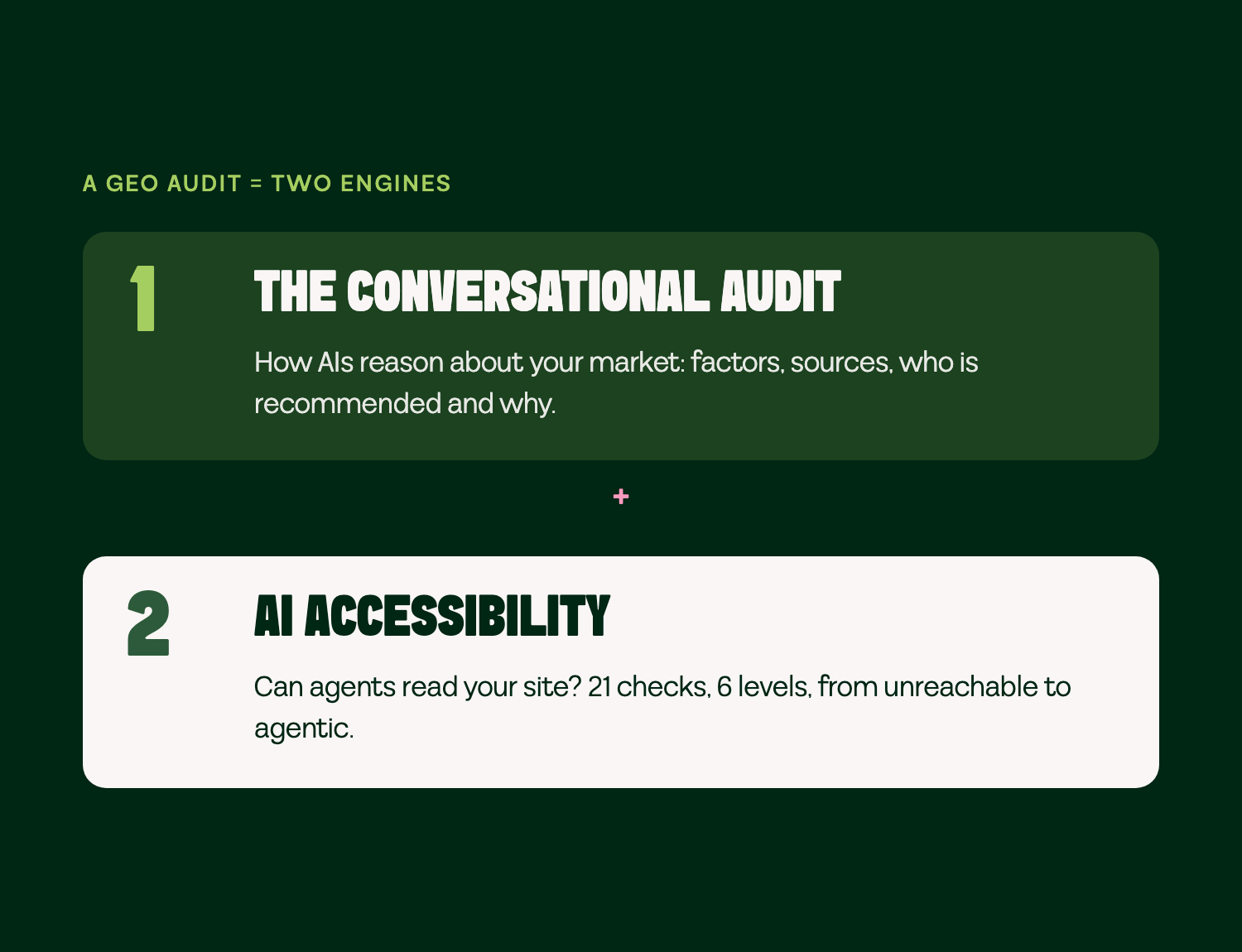
It combines two engines: conversational analysis (how the AI decides in your market) and AI accessibility (can agents read your site). The method takes 8 steps and 3 weeks:
Framing: one brand, one product range
AI conversations at scale
The decision factors
The trusted sources: discovery and coverage
Scoring against the real competitors
AI accessibility (21 checks)
The action plan: four prioritised workstreams, the text to publish already written
Measuring AI traffic
The method on video
How we made ChatGPT our #1 acquisition channel in 3 months: Franck Neuenschwander, CEO of Botanik, walks through the audit step by step. Why we stopped prompt tracking, what conversational analysis really finds, the KPIs tracked after the audit, and the results of Botanik and a car manufacturer. 19 chapters: jump straight to the step you need. Translated from the French original and dubbed with an AI clone of Franck's voice.
A year ago, a good Google ranking gave you two AI citations out of three. Today, one out of three. SEO and GEO have split up, and most brands haven't noticed, because nobody measures.
An electrical equipment e-retailer, convinced it was well placed: mentioned in 20% of AI answers, recommended in 0%, absent from 80%. Even when the AI cited it, it never said “I'd go with this one”. The audit tells you which box you're in, factor by factor.
Absent
The AI doesn't cite you
You don't exist in the buying conversation. Your competitor does.
Mentioned
Cited, no preference
You're on the list, but the AI doesn't push you forward. Second choice, low traffic.
Recommended
The option to pick
The AI presents you as the right choice. That's where the traffic and the leads go.
The mechanics
The conversational audit: understanding how AIs reason about your market. Which criteria trigger a recommendation, which sources count as proof, who is recommended today and why.
The AI accessibility audit: checking that your site is technically readable by agents. You can be the best answer on the market: if AI bots can't read you, you don't exist.
The two add up. Perfect content on an unreadable site is useless; a perfectly accessible site that covers no decision factor, just as much.
A confession: we started, like everyone else, with prompt tracking. Questions sent through an API, a citation counter, a nice chart. But I spent fifteen years in-house, on the brand side: data I can't prove, I don't present. And that one, I couldn't.
There's no way to anticipate what your customers actually type. The slightest change in wording changes the answer: fifty hand-picked prompts represent nobody.
Most tools query the models through the API: often a different model, a stripped-down context, a blank account. Your customers have a history and personalisation. You're measuring a signal nobody sees.
Knowing whether you're cited says neither why, nor what to fix. Conversational analysis surfaces the criteria and the sources that tip the recommendation.
8 steps, 3 weeks of audit
One year on · car manufacturer
×5.8AI traffic
from 461 to 2,694 AI sessions per month
01 → 04
The diagnosis
01 Framing: brand, industry, scope, a single product range per audit. And your starting AI traffic, section by section.
02 AI conversations: agents hold multi-turn conversations with the assistants, like real buyers, with Oracle.
03 Decision factors: the criteria the AI uses to decide in your market.
04 Trusted sources: where the AI spots brands (Reddit, Wikipedia, comparison sites), and where it checks each factor.
Week 1
05 → 06
The verdict
05 Scoring: recommended, mentioned or absent, factor by factor, against the competitors the AI detects on its own.
06 AI accessibility: 21 technical checks, a level from 0 to 5, the gap with your competitors.
Week 2
07
The debrief
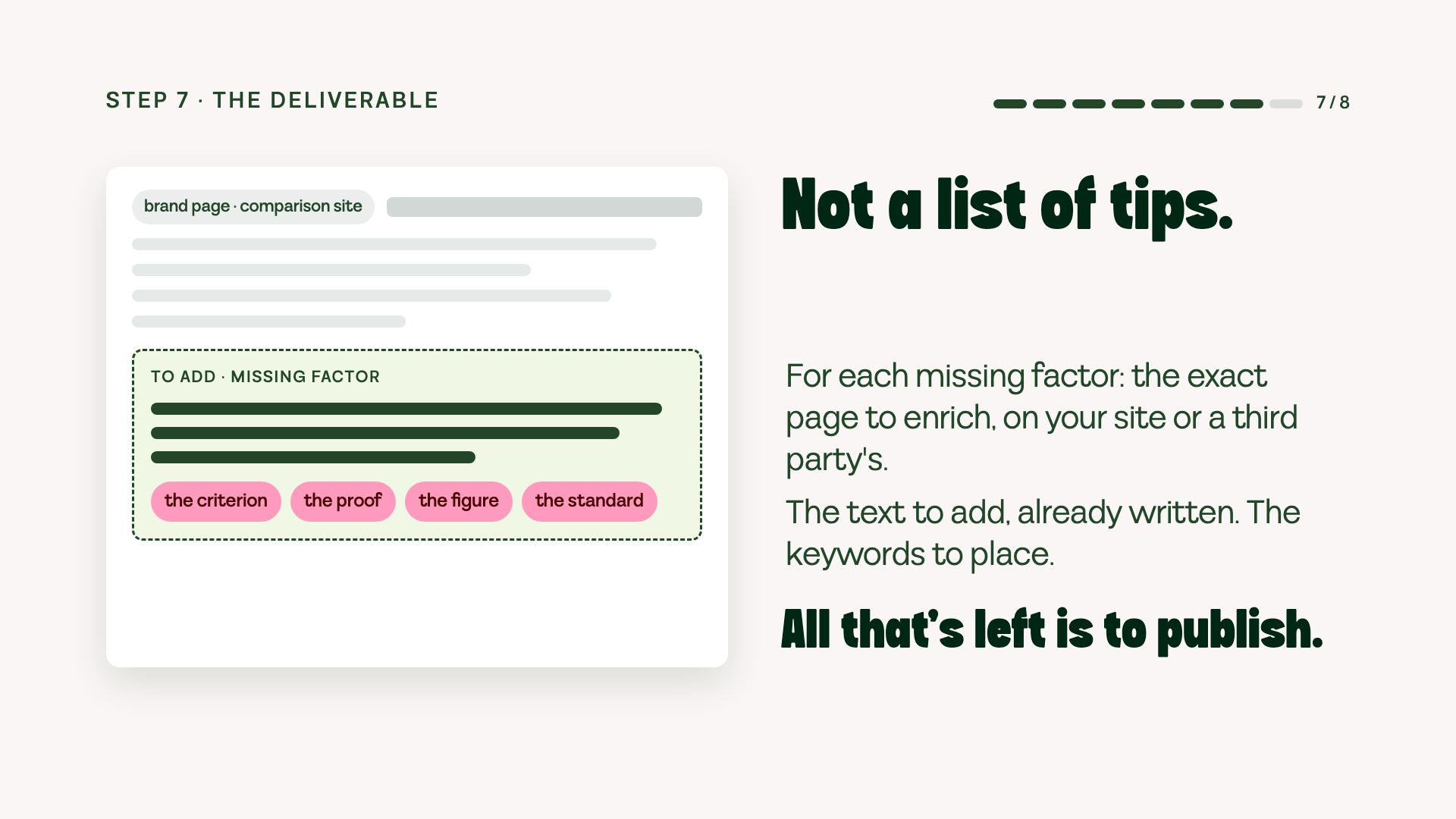
07 Action plan: four prioritised workstreams, one per pillar. For each missing factor, the exact page to enrich and the text to publish, already written. Presented live.
Week 3
08
The follow-up
08 Measurement: AI traffic and AI accessibility every month in your reporting, re-audit every quarter.
At a car manufacturer: ×5.8 AI traffic in one year.
Months 1 to 12
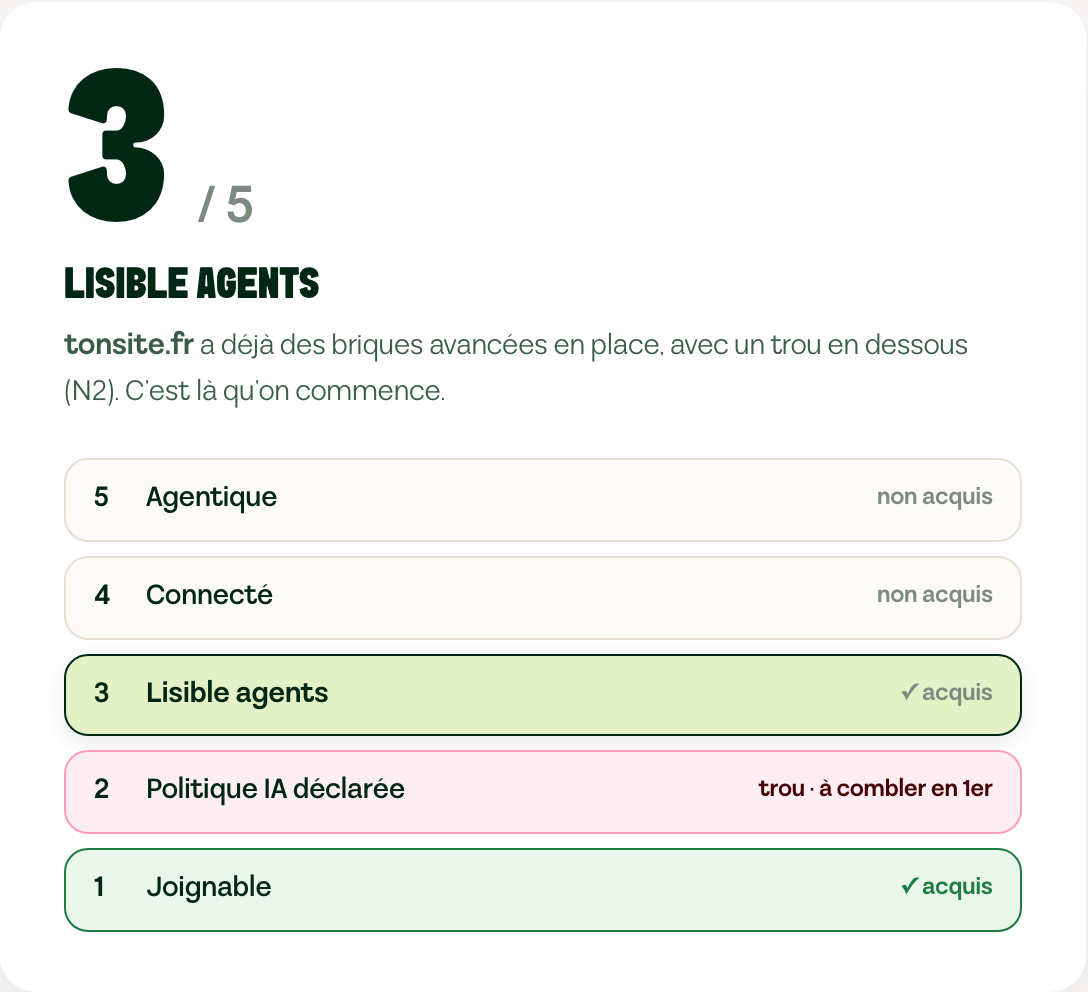
Level 1 is the only real door: a bot blocked at the firewall makes everything else pointless. Above it, the level shown is the highest tier reached, and every missing tier below is a gap to fill first.
| Level | Name | What is checked | What it changes |
|---|---|---|---|
| 0 | Unreachable | Firewall or robots.txt blocking AI bots | Nothing else counts: fix this first |
| 1 | Reachable | Homepage accessible, robots.txt open to AI bots | The only real door |
| 2 | AI policy declared | AI bots named and allowed, Content Signals | You tell the AIs what they're allowed to do |
| 3 | Agent-readable | llms.txt, content served as markdown, Link headers | LLMs read your content without the clutter |
| 4 | Connected | Discoverable APIs and authentication | An agent can plug into your service |
| 5 | Agentic | MCP, A2A, agentic commerce | An agent can act and buy from you |
Step 6 in practice
The scan gives a verdict out of 5 in about thirty seconds, tier by tier. In this example, a site already “agent-readable” (level 3) with a gap at level 2: no AI policy declared.
A site that skips a tier stays fragile. We fill that gap first, the rest is already in place.
Against your competitors
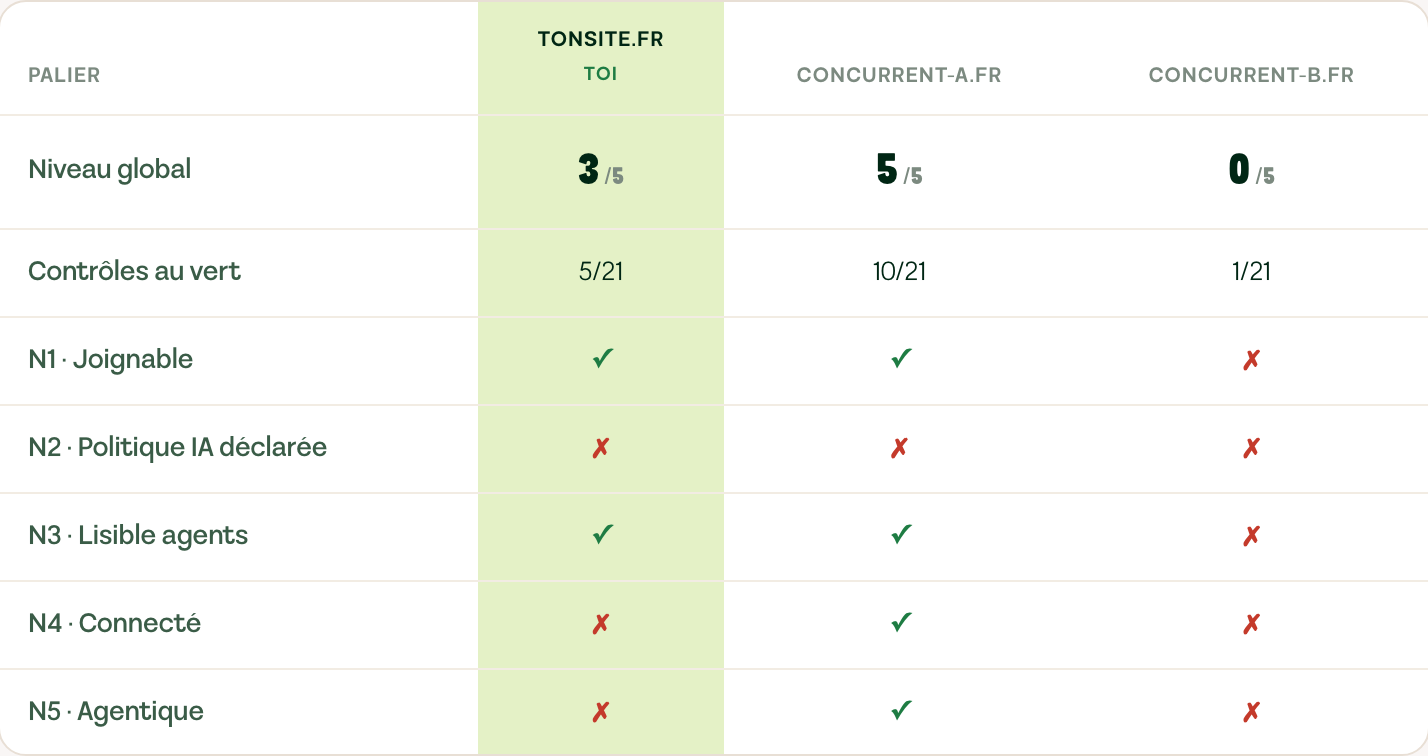
Up to three competitors, really scanned with the same 21 checks. Here (domains masked), one competitor is already agentic, another unreachable: two gaps no SEO tool shows.
Your report shows the real domains, and the matrix of the 21 checks, site by site.
Step 7 in practice
One workstream per pillar, each with its priority (high, medium or low) depending on what the audit found:
Your site: cover each missing factor, page by page. One question asked to the AI triggers dozens of others (the fan-out); the page has to answer them, and structured data takes the technical questions.
Discovery sources: earn mentions where the AI spots the brands that exist: Reddit, Wikipedia, Wikidata.
Coverage sources: where it checks each factor: comparison sites, review sites, specialist media. Low-cost press releases and guest articles on authority sites act as accelerators.
AI accessibility: from the simplest (robots.txt, sitemap, llms.txt) to the most advanced (markdown, agentic commerce), gap by gap.
And the deliverable is not a list of tips. For each missing factor: the exact page to enrich, on your site or a third party's, the text to add, already written, and the keywords to place. All that's left is to publish.
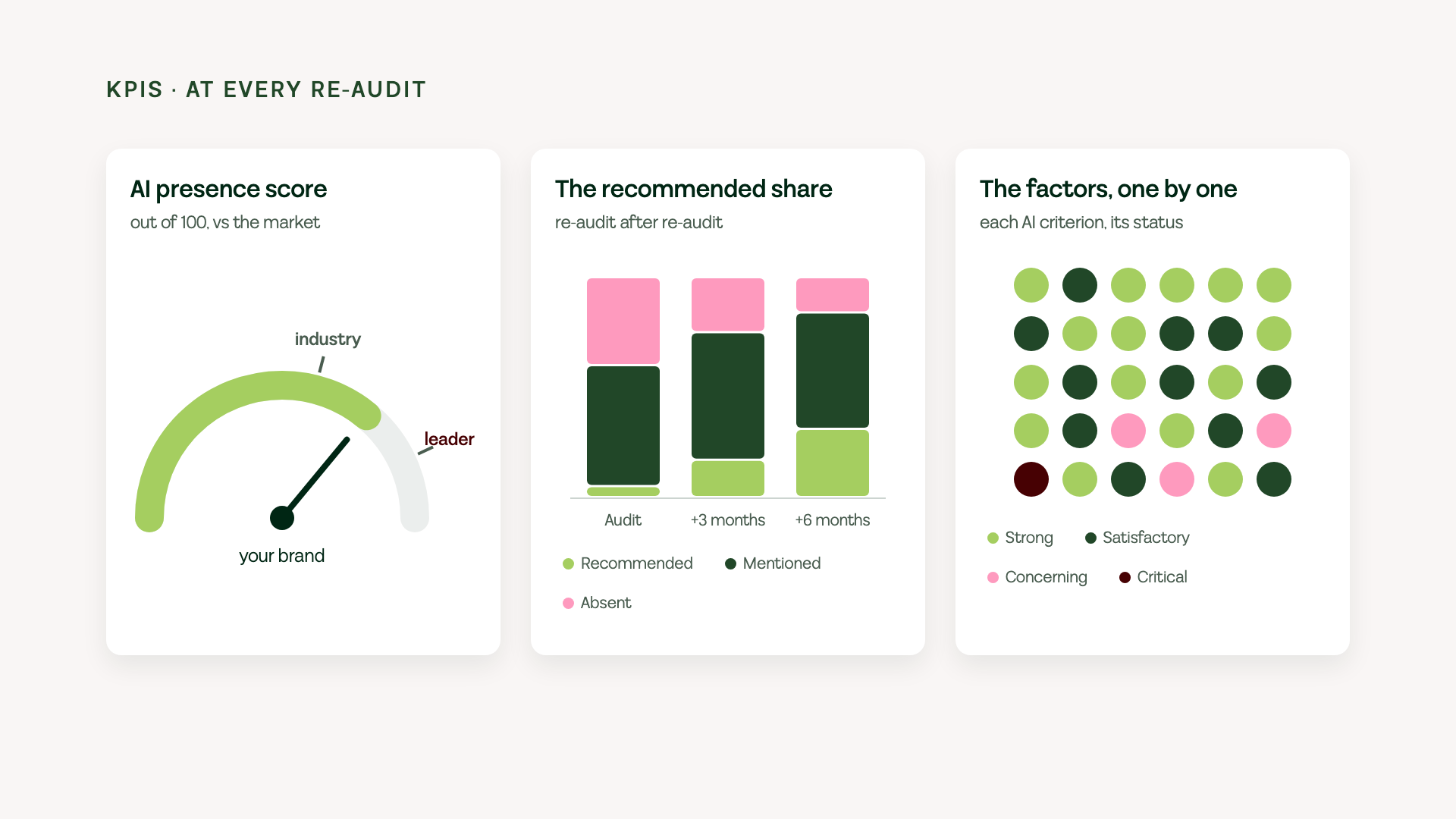
After the audit · at every re-audit
They come out of the conversational audit, and we record them at every re-audit, usually every quarter.
The AI presence score, out of 100, read against the industry average and the leader in your category.
The recommended share. Recommended, mentioned or absent: a good presence score can hide a brand that is mostly mentioned. The recommended share is what we push up, re-audit after re-audit.
The decision factors, one by one: strong, satisfactory, concerning or critical. The concerning ones become the quarter's work list.
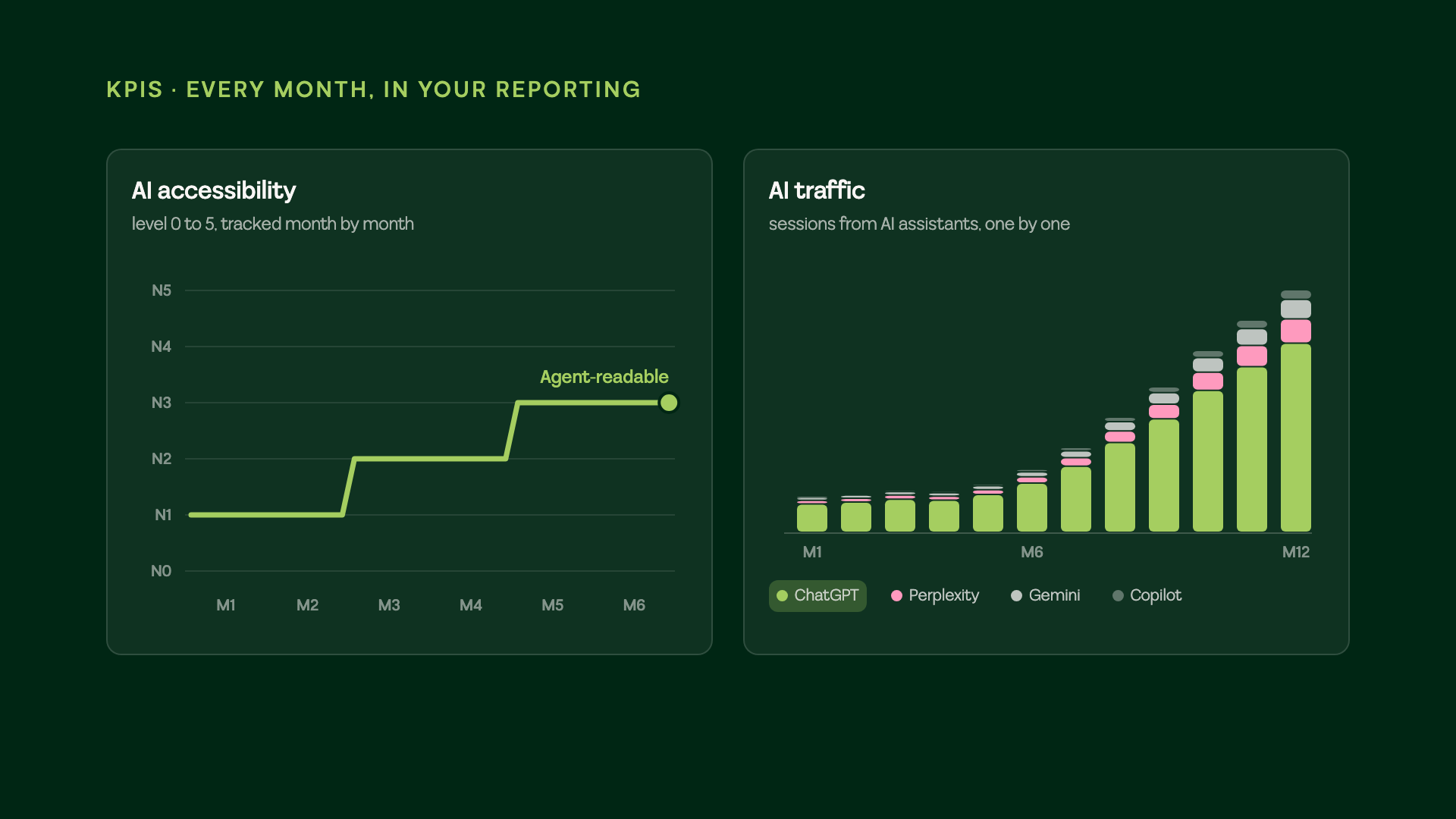
After the audit · every month
AI accessibility: the 21 checks rerun at every report, the 0 to 5 level logged over time. You see the tier you gained, and the one still missing.
AI traffic: sessions from ChatGPT, Perplexity, Gemini or Copilot, AI by AI, with conversions when your analytics tracks them. It's the KPI that says whether the rest is working.
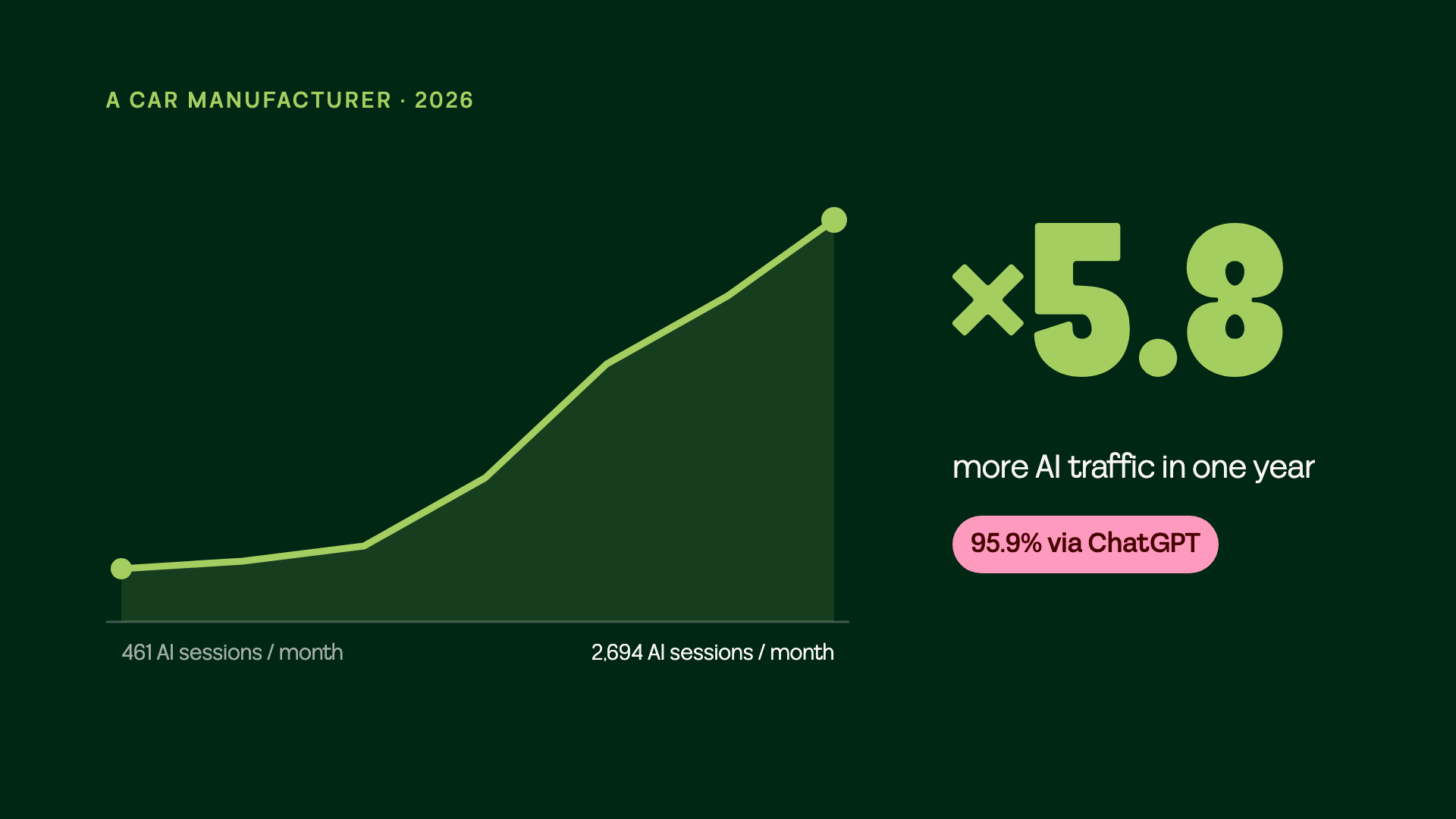
Use case · car manufacturer
A car manufacturer (we can't name it) ran this method on one product range: conversational audit in the spring, 2,527 searches, 30 factors, 20 trusted sources including 5 where it was absent. Then the action plan: content and link building on the AI sources.
Two months after going live, the curve takes off. One year on: from 461 to 2,694 AI sessions per month, 95.9% of them via ChatGPT. On the range's key page, Google clicks went from 573 to 24,895: content that covers a decision factor serves both engines.
The caveats, because we always give them: part of the gain comes from demand created by a public scheme that year, and 2,694 sessions a month is still small next to the same site's SEO. The point is the slope.
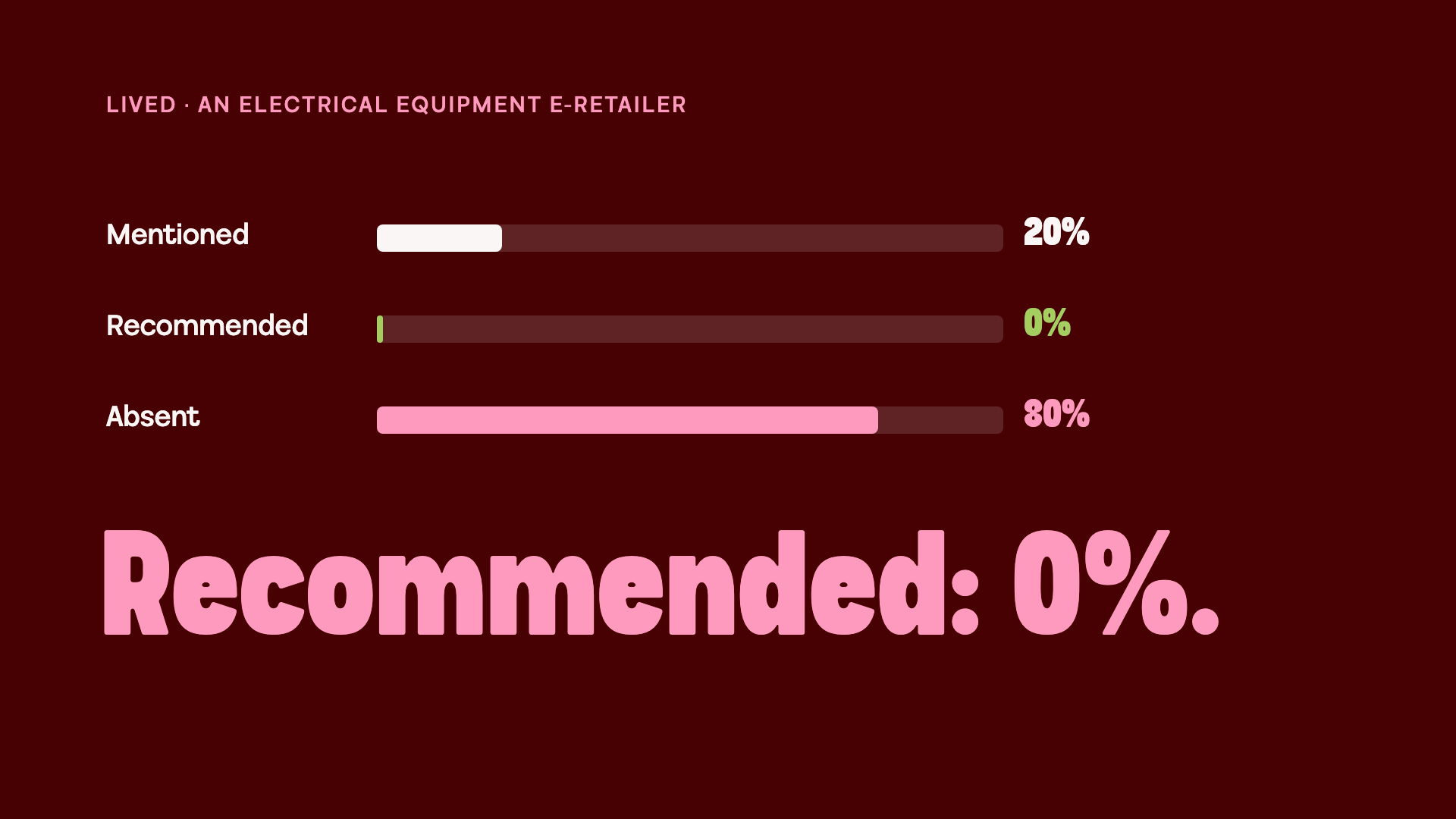
Use case · e-commerce, electrical equipment
Mentioned in 20% of answers, recommended in 0%, absent from 80%. It's the reading we see most often in a first audit: a brand that's solid in classic SEO, invisible when the AIs decide.
If you've never measured, it's probably your starting line too. The good news: the missing factors and sources can be listed, so they can be worked on.
No. SEO structures indexability and organic visibility; the GEO audit adds the AI layer: being understood, compared and recommended. The two add up, and the content work serves both: in the car manufacturer case, AI traffic was multiplied by 5.8 and Google clicks on the key page went from 573 to 24,895.
Most of the work is done on the most used model (ChatGPT, around 60% of the AI assistant market in France), with cross-checks on Gemini and Claude. The decision constants vary little from one model to the next: the same factors and the same sources come up. We don't sell an engine-by-engine verdict.
Three weeks from framing to the live debrief, for one product range.
€2,670 one-shot, deducted from your first month if you continue with a retainer: the details are on our public price grid. The quote is free.
The accessibility part, yes: the scanner is free (21 checks, level 0 to 5, competitor comparison). The conversational part takes thousands of multi-turn conversations on recent models: a handful of prompts typed into ChatGPT doesn't give a stable result.
AI answers move with market news and model updates. One re-audit per quarter on the priority range is the right pace; AI traffic is tracked every month.
On your priority range, in the answers ChatGPT gives your customers: if you can't answer with a number, nobody is measuring. Start with the free scan; for the full picture, request the audit.
GEO audit
Your place in AI answers
Absent, mentioned or recommended: we measure, factor by factor, and tell you what to fix.